
The Design Sprint is our five-day workshop for testing new ideas with real customers. On Monday, you make a map of your customer’s problem. On Tuesday, you sketch solutions. On Wednesday, you decide which sketches are strongest. On Thursday, you build a realistic prototype. And on Friday, you test that prototype with five target customers.
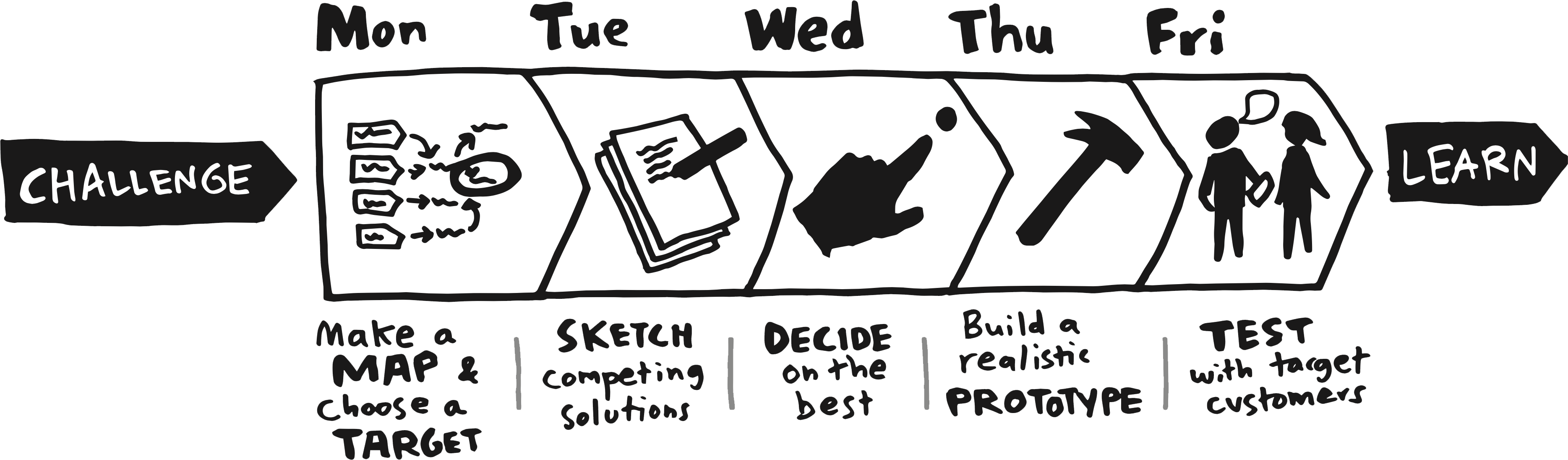
As the cost of building products moves toward zero with AI, the Design Sprint offers a practical, proven method for deciding what to build and how to stand out from the competition.
In a Design Sprint, you will:
- Test the key hypotheses behind your product or business
- Rapidly build realistic prototypes that are optimized for answering key questions
- Run effective customer interviews that give you concrete, actionable results
- Make fast, high-quality decisions without endless debate or cognitive biases
- Condense months of product and strategy work into one week
But the Design Sprint is not just about efficiency. It’s also an excellent way to stop the old defaults of work and replace them with a smarter and more effective way of solving problems that brings out the best contributions of everyone on the team and helps you spend your time on work that really matters.
You can run your own Design Sprint using our Miro template, our book Sprint, and this guide.
Set the Stage
❏ Choose a big challenge. Use sprints when the stakes are high, when there’s not enough time, or when you’re just plain stuck.
❏ Get a Decider (or two). Without a Decider, decisions won’t stick. If your Decider can’t join the entire sprint, have her appoint a delegate who can.
❏ Recruit a sprint team. Seven people or fewer. Get diverse skills along with the people who work on the project day-to-day.
❏ Schedule extra experts. Not every expert can be in the sprint all week. For Monday afternoon, schedule 20-minute interviews with extra experts. Plan for two to three hours total.
❏ Pick a Facilitator. She will manage time, conversations, and the overall sprint process. Look for someone who’s confident leading a meeting and synthesizing discussions on the fly. It might be you!
❏ Block five full days on the calendar. Reserve time with your sprint team from 10am to 5pm Monday through Thursday, and 9am to 5pm Friday.
❏ Book a room with two whiteboards. Reserve a sprint room for the entire week. If it doesn’t have two whiteboards in it already, buy some or improvise. Book a second room for Friday’s interviews.
❏ Or work online. Use our Miro template and Zoom to run your sprint remotely. It's less fun but more practical.
Key Ideas
- No distractions. Shut down messaging and media while you’re in the sprint. If you need to check in, duck out or wait for a break.
- Timebox. A tight schedule builds confidence in the sprint process. Use a Time Timer to create focus and urgency.
- Plan for a late lunch. Snack break around 11:30am and lunch around 1pm This schedule maintains energy and avoids lunch crowds.
Sprint Supplies
❏ Computer with external monitor. Miro works best on a device with lots of RAM and a huge display.
❏ Fast internet. For low-latency collaboration in Zoom and Miro.
❏ Quality camera. Optional, but a nice camera helps the team come to life even if they are not in the same room.
❏ Black felt-tip pens. For sketching. Avoid super-thin pens that encourage microscopic writing. We like the medium-point Paper Mate Flair. Get ten pens.
❏ Printer paper. For sketching (sadly, not everything fits on a sticky note). Get one hundred sheets, letter-size or A4.
❏ Time Timers. For keeping time throughout the sprint. Get two: one to keep the current activity on time, and one to remind you when to take a break.
❏ Healthy snacks. Good snacks will help keep your team’s energy up throughout the day. Eat real food like apples, bananas, yogurt, cheese, and nuts. For a boost, have dark chocolate, coffee, and tea. Get more than enough for everybody.
If you’re working in person, you’ll also need:
❏ Lots of whiteboards. Wall-mounted are best, but rolling whiteboards are good, too. Alternatives: IdeaPaint, Post-it easel pads, or butcher paper taped to the walls. Get two big whiteboards (or equivalent surface area).
❏ Yellow 3-by-5 sticky notes. Stick with classic yellow, because the multicolored notes cause unnecessary cognitive load. Get fifteen pads.
❏ Black whiteboard markers. Using a thick marker will keep your ideas pithy and easy for others to read. We prefer whiteboard markers over Sharpies because they’re more versatile, they smell less, and you don’t have to worry about accidentally putting a permanent mark on your whiteboard. Get ten markers.
❏ Green and red whiteboard markers. For Friday’s observation notes. Get ten of each color.
❏ Masking tape. For posting solution sketches on the walls. Get one roll.
❏ Small dot stickers (¼"). For heat map votes. Must be all the same color (we like blue). If you’re searching online, these are often called “Round Color Coding Labels.” Get about two hundred small dots.
❏ Large dot stickers (¾"). For How Might We votes, straw poll, and supervotes. Must be all the same color, and a different color than the small dots (we like pink or orange). Get about one hundred large dots.
Monday
Note: Schedules are approximate. Don’t worry if you run behind. Remember to take breaks every sixty to ninety minutes (or around 11:30am and 3:30pm each day).
10am
❏ Write this checklist on a whiteboard. When you’re done, check off this first item. See how easy that was? Keep checking off items throughout the day.
❏ Introductions. If some people don’t know one another, do a round of introductions. Point out the Facilitator and the Decider and describe their roles.
❏ Explain the Design Sprint. Introduce the five-day sprint process. Run through this checklist and briefly describe each activity.
10:15-ish
❏ Set a long-term goal. Get optimistic. Ask: Why are we doing this project? Where do we want to be in six months, a year, or even five years from now? Write the long-term goal on a whiteboard.
❏ List the risks. Get pessimistic. Ask: How could we fail? Turn these fears into questions you could answer this week. List them on a whiteboard.
11:30-ish
❏ Make a map. List customers and key players on the left. Draw the ending, with your completed goal, on the right. Finally, make a flowchart in between showing how customers interact with your product. Keep it simple: five to fifteen steps.
1pm
❏ Lunch break. Eat together if you can (it’s fun). Remind your team to choose a light lunch to maintain energy in the afternoon. There are snacks if you get hungry later.
2pm
❏ Ask the Experts. Interview experts on your sprint team and guests from the outside. Aim for fifteen to thirty minutes each. Ask about the vision, customer research, how things work, and previous efforts. Pretend you’re a reporter. Update long-term goal, questions, and map as you go.
❏ Explain How Might We notes. Distribute whiteboard markers and sticky notes. Reframe problems as opportunities. Start with the letters “HMW” on the top left corner. Write one idea per sticky note. Make a stack as you go.
4-ish
❏ Organize How Might We notes. Stick all the How Might We notes onto a wall in any order. Move similar ideas next to one another. Label themes as they emerge. Don’t perfect it. Stop after about ten minutes.
❏ Vote on How Might We notes. Each person has two votes, can vote on his or her own notes, or even the same note twice. Move winners onto your map.
4:30-ish
❏ Pick a target. Circle your most important customer and one target moment on the map. The team can weigh in, but the Decider makes the call.
Key Ideas
- Start at the end. Start by imagining your end result and risks along the way. Then work backward to figure out the steps you’ll need to get there.
- Nobody knows everything. Not even the Decider. All the knowledge on your sprint team is locked away in each person’s brain. To solve your big problem, you’ll need to unlock that knowledge and build a shared understanding.
- Reframe problems as opportunities. Listen carefully for problems and use “How might we” phrasing to turn them into opportunities.
Facilitator Tips
- Ask for permission. Ask the group for permission to facilitate. Explain that you’ll try to keep things moving, which will make the sprint more efficient for everyone.
- ABC: Always be capturing. Synthesize the team’s discussion into notes on the whiteboard. Improvise when needed. Keep asking, “How should I capture that?”
- Ask obvious questions. Pretend to be naive. Ask “Why?” a lot.
- Take care of the humans. Keep your team energized. Take breaks every sixty to ninety minutes. Remind people to snack and to eat a light lunch.
- Decide and move on. Slow decisions sap energy and threaten the sprint timeline. If the group sinks into a long debate, ask the Decider to make a call.
Tuesday
10am
❏ Lightning Demos. Look at great solutions from a range of companies, including yours. Three minutes per demo. Capture good ideas with a quick drawing on the whiteboard.
12:30-ish
❏ Divide or swarm. Decide who will sketch which part of the map. If you’re targeting a big chunk of the map in your sprint, divide it up and assign someone to each section.
1pm
❏ Lunch
2pm
The Four-Step Sketch. Briefly explain the four steps. Everyone sketches. When you’re done, place the sketches in a pile and save them for tomorrow.
❏ 1. Notes. Twenty minutes. Silently walk around the room and gather notes.
❏ 2. Ideas. Twenty minutes. Privately jot down some rough ideas. Circle the most promising ones.
❏ 3. Crazy 8s. Eight minutes. Fold a sheet of paper to create eight frames. Sketch a variation of one of your best ideas in each frame. Spend one minute per sketch.
❏ 4. Solution sketch. Thirty to ninety minutes. Create a three-panel storyboard by sketching in three sticky notes on a sheet of paper. Make it self-explanatory. Keep it anonymous. Ugly is okay. Words matter. Give it a catchy title.
Key Ideas
- Remix and improve. Every great invention is built on existing ideas.
- Anyone can sketch. Most solution sketches are just rectangles and words.
- Concrete beats abstract. Use sketches to turn abstract ideas into concrete solutions that can be assessed by others.
- Work alone together. Group brainstorms don’t work. Instead, give each person time to develop solutions on his or her own.
Recruit Customers for Friday’s Test
❏ Put someone in charge of recruiting. It will take an extra one or two hours of work each day during the sprint.
❏ Write a screener survey. Ask questions that will help you identify your target customers, but don’t reveal who you’re looking for.
❏ Find customers where they hang out. Business professionals? Find customers on LinkedIn. Consumer enthusiasts? Look for a subreddit. General population? Consider running ads. Be resourceful — ask friends, investors, and supporters to help with outreach.
❏ Use a recruiting service if necessary. If you're having a hard time finding customers, use a research recruiting service like UserTesting.
❏ Follow up with email and phone calls. Throughout the week, make contact with each customer to make sure he or she shows up on Friday.
For a detailed guide to Friday's test, check out the 4-day research sprint we created at Google Ventures.
Wednesday
10am
The sticky decision. Follow these five steps to choose the strongest solutions:
❏ Art museum. Tape the solution sketches to the wall in one long row.
❏ Heat map. Have each person review the sketches silently and put one to three small dot stickers beside every part he or she likes.
❏ Speed critique. Three minutes per sketch. As a group, discuss the highlights of each solution. Capture standout ideas and important objections. At the end, ask the sketcher if the group missed anything.
❏ Straw poll. Each person silently chooses a favorite idea. All at once, each person places one large dot sticker to register his or her (nonbinding) vote.
❏ Supervote. Give the Decider three large dot stickers and write her initials on the sticker. Explain that you’ll prototype and test the solutions the Decider chooses.
11:30-ish
❏ Divide winners from “maybe-laters.” Move the sketches with supervotes together.
❏ Rumble or all-in-one. Decide if the winners can fit into one prototype, or if conflicting ideas require two or three competing prototypes in a Rumble.
❏ Fake brand names. If you’re doing a Rumble, use a Note-and-Vote to choose fake brand names.
1pm
❏ Lunch
2pm
❏ Make a storyboard. Use a storyboard to plan your prototype.
❏ Draw a grid. About fifteen squares on a whiteboard.
❏ Choose an opening scene. Think of how customers normally encounter your product or service. Keep your opening scene simple: web search, magazine article, store shelf, etc.
❏ Fill out the storyboard. Move existing sketches to the storyboard when you can. Draw when you can’t, but don’t write together. Include just enough detail to help the team prototype on Thursday. When in doubt, take risks. The finished story should be five to fifteen steps.
Facilitator Tip
- Don’t drain the battery. Each decision takes energy. When tough decisions appear, defer to the Decider. For small decisions, defer until tomorrow. Don’t let new abstract ideas sneak in. Work with what you have.
Thursday
10am
❏ Pick the right tools. Don’t use your everyday tools. They’re optimized for quality. Instead, use tools that are rough, fast, and flexible.
❏ Divide and conquer. Assign roles: Maker, Stitcher, Writer, Asset Collector, and Interviewer. You can also break the storyboard into smaller scenes and assign each to different team members.
❏ Prototype!
1pm
❏ Lunch
2pm
❏ Prototype!
❏ Stitch it together. With the work split into parts, it’s easy to lose track of the whole. The Stitcher checks for quality and ensures all the pieces make sense together.
3-ish
❏ Do a trial run. Run through your prototype. Look for mistakes. Make sure the Interviewer and the Decider see it.
❏ Finish up the prototype.
Throughout the Day
❏ Write interview script. The Interviewer prepares for Friday’s test by writing a script.
❏ Remind customers to show up for Friday’s test. Email is good, phone call is better.
❏ Buy gift cards for customers. We usually use $100 gift cards.
Key Ideas
- Prototype mindset. You can prototype anything. Prototypes are disposable. Build just enough to learn, but not more. The prototype must appear real.
- Goldilocks quality. Create a prototype with just enough quality to evoke honest reactions from customers.
Friday
If you're doing interviews in person, you'll need to set up a makeshift research lab. For more detailed advice, check out this guide from Michael Margolis.
❏ Two rooms. In the sprint room, the sprint team will watch a video feed of the interviews. You’ll need a second, smaller room for the actual interviews. Make sure the interview room is clean and comfortable for your guests.
❏ Set up hardware. Position a webcam so you can see customers’ reactions. If your customer will be using a smartphone, iPad, or other hardware device, set up a document camera and microphone.
❏ Set up video stream. Use any video-conferencing software to stream video to the sprint room. Make sure the sound quality is good. Make sure the video and audio are one-way only.
Key Ideas
- Five is the magic number. After five customer interviews, big patterns will emerge. Do all five interviews in one day.
- Watch together, learn together. Don’t disband the sprint team. Watching together is more efficient, and you’ll draw better conclusions.
- A winner every time. Your prototype might be an efficient failure or a flawed success. In every case, you’ll learn what you need for the next step.
Five-Act Interview
❏ Friendly welcome. Welcome the customer and put him or her at ease. Explain that you’re looking for candid feedback.
❏ Context questions. Start with easy small talk, then transition to questions about the topic you’re trying to learn about.
❏ Introduce the prototype. Remind the customer that some things might not work, and that you’re not testing him or her. Ask the customer to think aloud.
❏ Tasks and nudges. Watch the customer figure out the prototype on his or her own. Start with a simple nudge. Ask follow-up questions to help the customer think aloud.
❏ Debrief. Ask questions that prompt the customer to summarize. Then thank the customer, give him or her a gift card, and show the customer out.
Interviewer Tips
- Be a good host. Throughout the interview, keep the customer’s comfort in mind. Use body language to make yourself friendlier. Smile!
- Ask open-ended questions. Ask “Who/What/Where/When/ Why/How. . . ?” questions. Don’t ask leading “yes/no” or multiple-choice questions.
- Ask broken questions. Allow your speech to trail off before you finish a question. Silence encourages the customer to talk without creating any bias.
- Curiosity mindset. Be authentically fascinated by your customer’s reactions and thoughts.
Observing Interviews
Before the first interview:
❏ Draw a grid on a whiteboard. Create a column for each customer. Then add a row for each question you want to answer — these can be risks you identified Monday, hypotheses from your Foundation Sprint, or the assumptions behind your prototypes. This is your scorecard.
During each interview:
❏ Take notes as you watch. Hand out sticky notes and markers. Write down direct quotes, observations, and interpretations. Indicate positive or negative.
After each interview
❏ Vote yes or no. Use sticky notes to indicate whether the answer to the question for this customer is "yes" or "no."
❏ Decider chooses yes or no. The Decider considers everyone's votes and selects the overall "yes" or "no" for this question for this customer.
❏ Take a quick break.
At the end of the day:
❏ Decider chooses yes or no for each question. At the end of the day, the Decider selects a single "yes" or "no" for each question on the scorecard.
❏ Hot Takes & Next Steps. Each person writes down their "hot take" for the sprint and their proposed next steps. The Decider decides.
FAQs
Can I facilitate a Design Sprint without any experience?
Yes. With the book and the template, you have everything you need. In fact, you’re much better prepared than we were when we started out!
How should we prepare for our Design Sprint?
You should run a Foundation Sprint before your first Design Sprint. This is our new sprint method for the very beginning of big new projects. We even wrote a book about it: Click.
Do we really need five days for a Design Sprint?
Yes. Especially the first time, we find that teams need the full five days to properly plan, build a robust prototype, and find real customers to test with. Once you get more practice, you might be able to go faster. And follow-up sprints (the second or third in a sequence of sprints) are typically faster than the first.
Can we run a Design Sprint remotely?
Yes! We run most of our sprints remotely. With our official Miro template, you’ll have almost everything you need to run a Design Sprint over video.
Do Design Sprints work at big companies?
Yes. At big companies, it can be difficult to get time from the Decider and other experts. Focus on scheduling cameo appearances for Monday, and be sure to have the Decider delegate another decision maker who can participate every day.
Do Design Sprints work for hardware products?
Yes. The biggest challenge for a hardware sprint will be prototyping. Here are three techniques for creating a hardware prototype in one day: Modify or build on top of an existing product, even if it’s incomplete. Use 3D printing or other rapid fabrication techniques to prototype your product from scratch. Or create a Brochure Façade, which allows customers to react to your product without seeing the actual product.
Do Design Sprints work for [insert super-hard-to-prototype product or service here]?
Almost certainly. Adopt a “prototype mindset” and pretty much anything is possible.
Do Design Sprints work at nonprofits?
You bet. Just like startups, nonprofits have big challenges and limited resources. The definition of “target customer” might be different, but questions about nonprofit concerns like fund-raising, public relations, and community services can all be answered by prototyping and testing with real people.
Do Design Sprints work in classrooms?
Yes. The biggest challenge to running a sprint in a classroom is scheduling. If you can find a solid week, go for it! But if your class meets only once or twice a week for a few hours each session, you’ll have to be creative.
At Columbia and Stanford, professors have adapted the sprint process by having students do one “day” each class session (either in class, or as homework with their team). Dividing the process will create a lack of continuity, and a lot of “boot up” time each session. Help students out by encouraging them to take lots of photos. If possible, let them keep their maps, sprint questions, and other notes on Post-it easel pads or something similar.
Can I run a Design Sprint by myself?
Sort of. Don’t expect a solo sprint to be as good as a sprint with your team. But we’ve talked to people who have done it successfully, and the techniques for a sprint can be useful on your own. For example, set a timer and force yourself to come up with multiple solutions to a problem. Prototype your ideas to answer specific questions before diving into implementation. See below for more tips on how to use parts of the sprint.
Can we use parts of the Design Sprint without running a whole sprint?
Definitely! For a big challenge, use a full sprint. But there are lots of sprint techniques that are useful in other settings. If you need to make a small decision in a meeting, try a Note-and-Vote. If you find yourselves frustrated by problems, try writing How Might We notes (p. 73). If you’re talking about solutions in the abstract, do a Four-Step Sketch to make them concrete (p. 109). Every meeting benefits from a Time Timer and a facilitator writing notes on the whiteboard.
And you can conduct customer interviews (p. 204) at absolutely any time — with a prototype, with your real product, with competitors’ products, or even with no product at all. We guarantee you’ll learn something.
